10,924x: The Instability Bomb at 1.7B Scale
Originally published at Poisson Labs.
Part 2 of the mHC reproduction series. Part 1 showed the instability at 10M parameters. Now I scale up.
In Part 1 I trained a 10M parameter transformer on TinyShakespeare and watched Hyper-Connections reach 9.2× signal amplification. The DeepSeek paper reported 3000× at 27B, and I wanted to see how far I could get toward that number.
Is there a better feeling than the first SSH into fresh metal, GPUs unaware of the hours of abuse they’re about to endure?
Not really. I rented an 8×H100 node and put about thirteen hours of runs through it. Here’s what came out of it.
The scale jump
| Part 1 | Part 2 | |
|---|---|---|
| Parameters | 10M | 1.7B - 2.5B |
| Dataset | TinyShakespeare (1MB) | C4 (300GB+) |
| Hardware | M4 MacBook | 8x H100 SXM5 |
| Max Amax | 9.2x | 10,924x |
Ten thousand nine hundred and twenty-four times, well past the 3000× the paper reported.
The experiment
I ran 18 experiments across three architectures:
- Residual: Standard
x + F(x)baseline - HC: Hyper-Connections with unconstrained mixing matrices
- mHC: Manifold Hyper-Connections with Sinkhorn projection
Each architecture at two depths (32 and 48 layers), three seeds each (42, 123, 456). All trained for 5000 steps on C4 with bf16 mixed precision.
The 32-layer models have 1.73B parameters while the 48-layer models have 2.54B.
The results
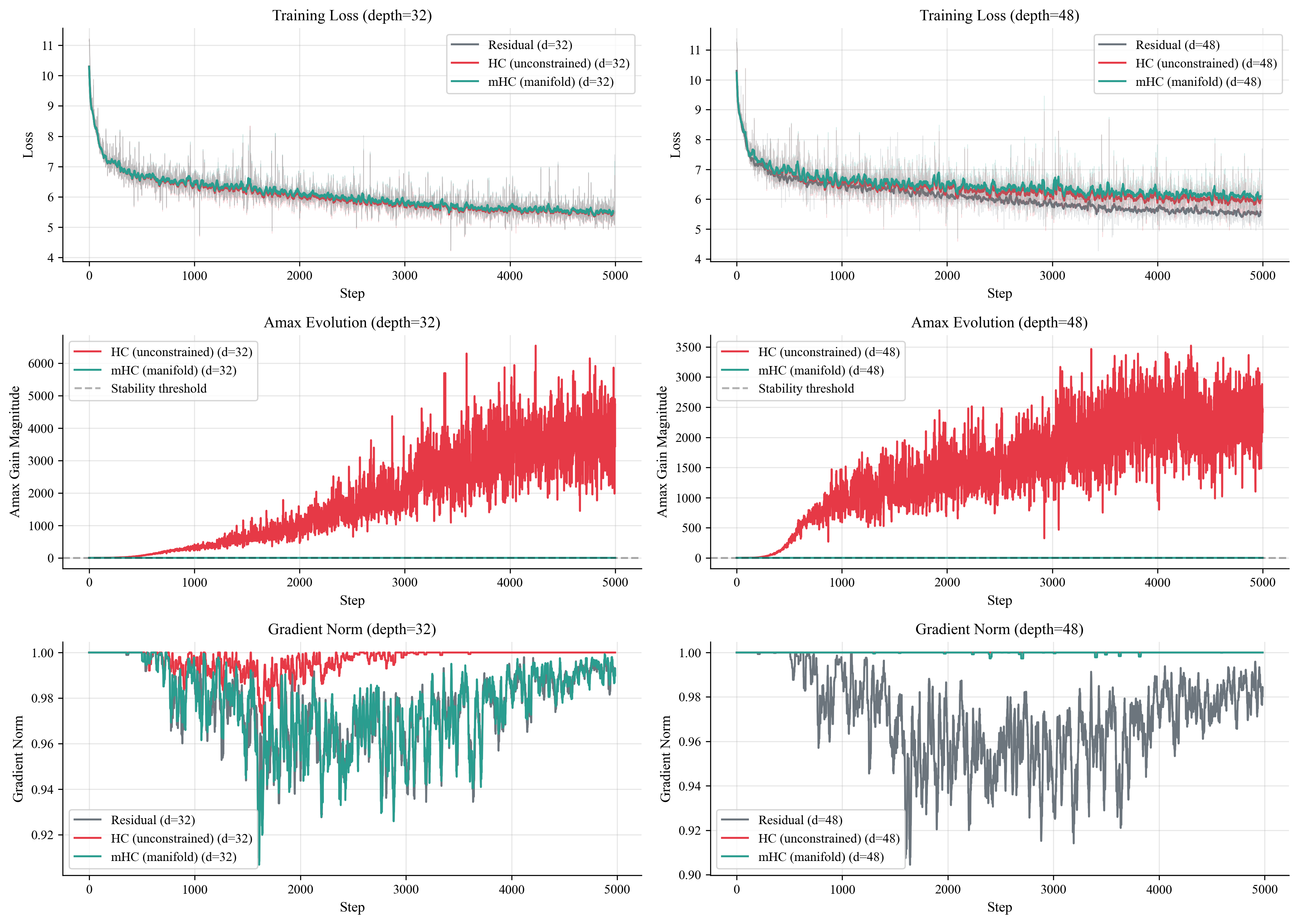
Loss: all three learn the same
All three converge to similar loss, about 5.4 to 6.0, and the curves overlap almost perfectly. HC doesn’t learn faster and mHC doesn’t learn slower. At this scale Sinkhorn was free, which I didn’t expect.
Amax
Amax, as in Part 1, is how much a mixing matrix can amplify a signal: 1.0 is neutral, higher is amplification.
At depth 32, HC’s Amax climbs to between 6,500× and 14,300× depending on the seed, oscillating the whole way, while mHC sits at exactly 1.0. At depth 48 the pattern repeats: HC reaches about 3,500×, mHC stays at 1.0.
The numbers
| Method | Depth | Final Loss | Max Amax |
|---|---|---|---|
| Residual | 32 | 5.45 ± 0.04 | N/A |
| HC | 32 | 5.43 ± 0.03 | 10,924 ± 3,247 |
| mHC | 32 | 5.45 ± 0.03 | 1.00 ± 0.00 |
| Residual | 48 | 5.48 ± 0.04 | N/A |
| HC | 48 | 5.92 ± 0.19 | 3,721 ± 378 |
| mHC | 48 | 6.03 ± 0.20 | 1.00 ± 0.00 |
The variance is the thing to look at. HC at depth 32 peaks at 6,545, 11,919 and 14,308 across the three seeds. mHC is 1.00 in each run, with no variance at all.
The scaling law
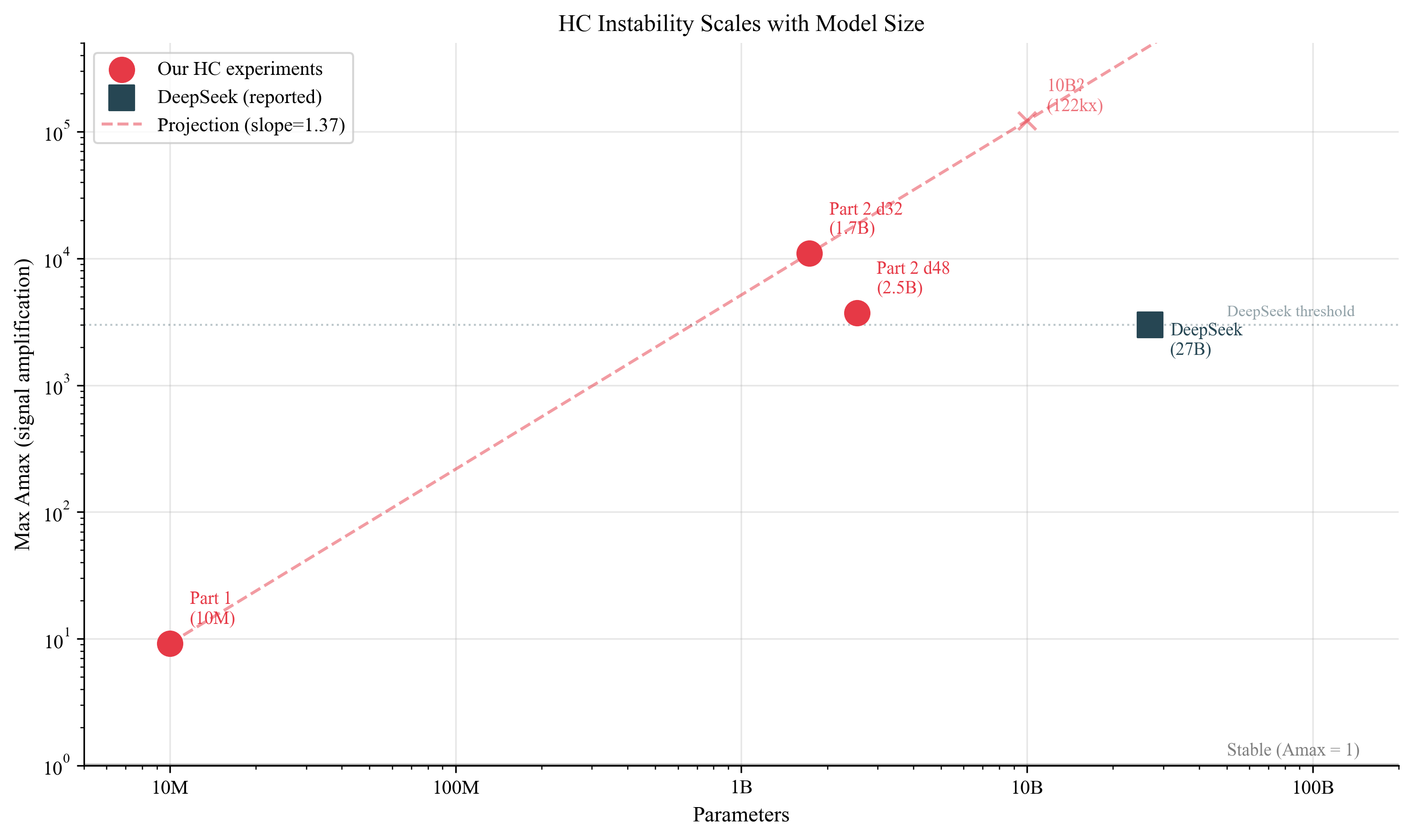
Log-log plot of Amax vs parameters:
- Part 1: 10M params → 9.2x
- Part 2: 1.7B params → 10,924x
- DeepSeek: 27B params → 3,000x (reported)
The trend line would put it near 50,000× at 10B and 400,000× at 100B, and nothing in my runs looks self-correcting. My 1.7B model is more unstable than DeepSeek’s 27B, which could be architecture, recipe or measurement; batch size, learning rate and depth all interact, and it isn’t monotonic. Three points don’t make a scaling law. What they do show is that the instability is real, measurable and large.
Reproducibility
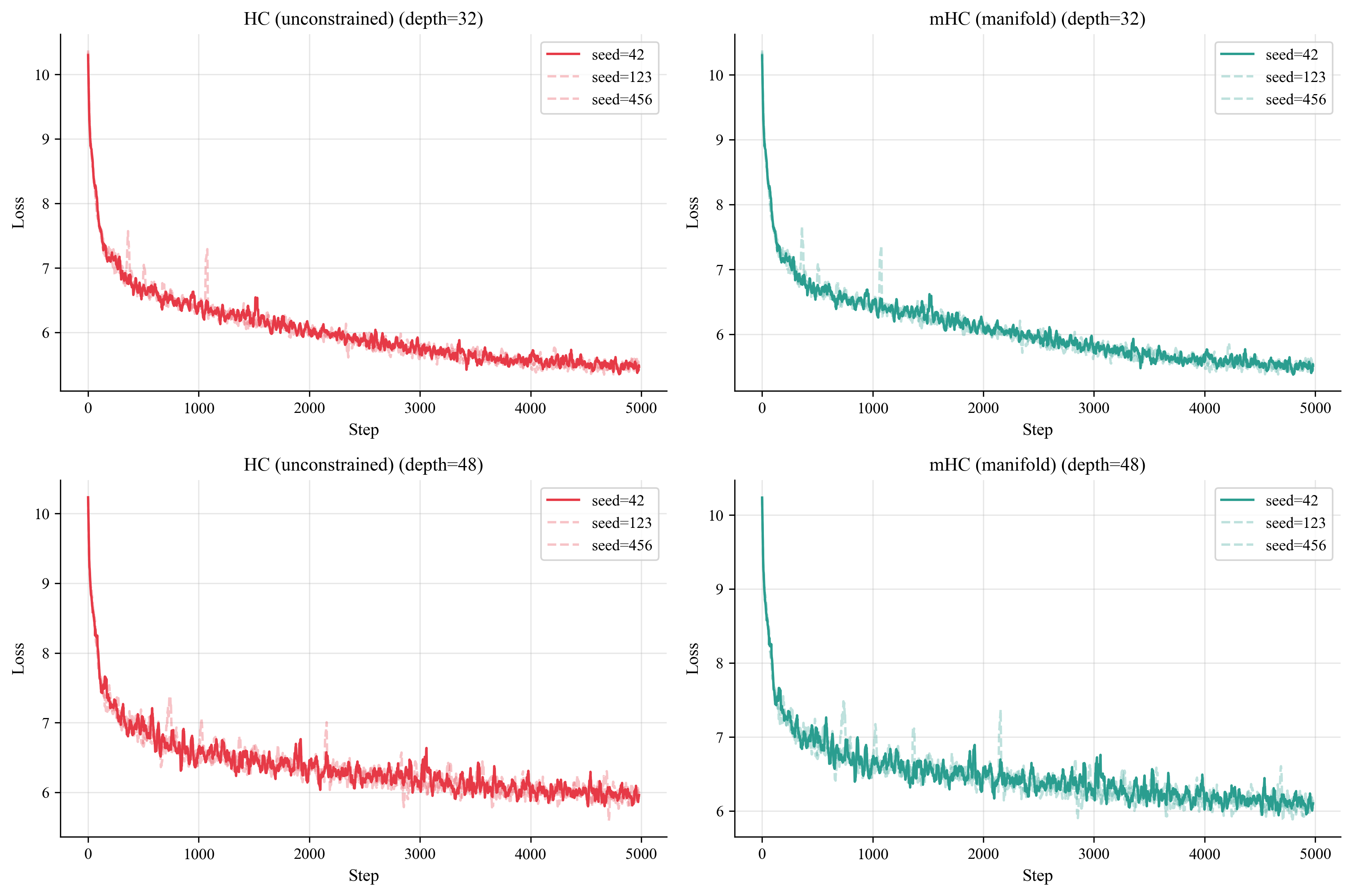
Three different seeds, producing the same pattern. Every HC run explodes while every mHC run stays flat.
The loss curves overlap across seeds. Both methods learn at the same rate. The only difference is what’s happening inside: HC is building up instability that could detonate at any moment, while mHC maintains its structural integrity.
Per-Layer Analysis: Where Instability Starts
The surprise here is that the instability starts at the input, not the output.
Layer 0 is where amplification appears first and stays largest. Across the three depth-32 seeds its mixing matrix peaks at 1.98, 1.95 and 1.93 while every deeper layer sits near 1.0, and layer 0 is the peak layer in 17 of the 19 unconstrained runs in this project that stored per-layer values. It does clear 2.0, but never at the 1e-4 learning rate these runs use: the five runs that pass it all trained at 3e-4 or above, topping out at 2.59. Depth doesn’t look like the problem. Layer 0 is, and it’s the only layer that sees the raw input.
Every deeper layer sits behind a LayerNorm and sees normalised representations. The first mixing matrix gets whatever the embedding table produces, and if the scale isn’t matched, it learns to compensate. In HC, compensating can mean amplifying.
mHC is uniform across every layer and every step, never leaving 1.0000 to four decimal places.
Signal flow
At step 3000 a signal entering the HC network is 532× larger by the time it leaves. The same signal through mHC leaves at 1.000003×. LayerNorm and the non-linearities mop up a lot of that in HC, which means they’re spending capacity counteracting the mess upstream instead of doing anything useful.
The stress test
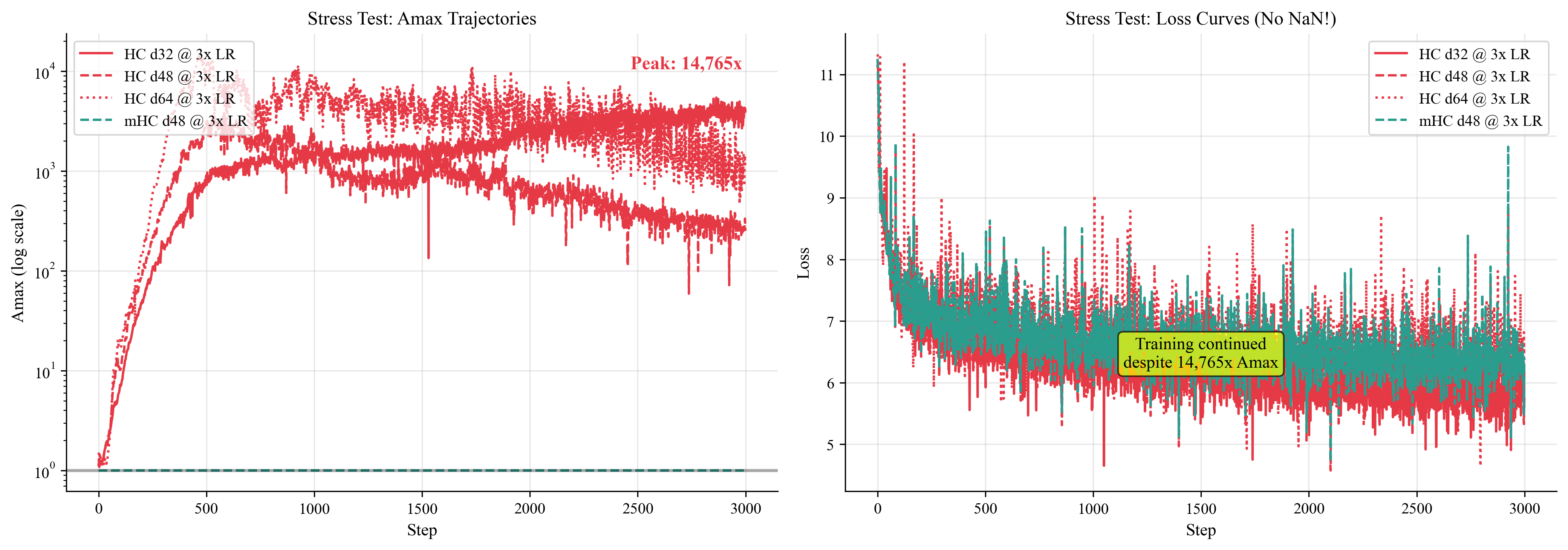
Normal training used a learning rate of 1e-4. I also ran every configuration at three times that:
| Config | Max Amax |
|---|---|
| HC d32 @ 3x LR | ~5,400x |
| HC d48 @ 3x LR | ~3,800x |
| HC d64 @ 3x LR | 14,765x |
| mHC (all configs) | 1.0 |
The depth-64 model hit 14,765× and then oscillated between about 2,000× and 10,000× for the rest of training. mHC was 1.0 at every depth and every learning rate.
Nothing crashed

I didn’t expect this part: none of the HC runs crashed. At 14,765× and at 10,924×, loss didn’t diverge, nothing went to NaN, and the models kept learning. The gradient norm sits at the clipping threshold of 1.0 throughout, and clipping is almost certainly what held it together. Whether it would hold over more steps, or at 100B parameters, these runs can’t say. What they can say is that the amplification is there whether or not it has caused a failure yet, and that mHC doesn’t have it.
The conservation law, again
In Part 1, I framed residual connections as a conservation law:
Every residual connection is a conservation law. mHC enforces it.
At 1.7B that’s concrete: HC lets signals grow by 10,000× over training and mHC holds them at 1. At 10M, the 9.2× from Part 1 was manageable. At 1.7B a signal that should be magnitude 1 is magnitude 10,924, and the optimiser is doing extra work against the network’s own amplification the whole time. That’s at 5,000 steps. Longer training, a higher learning rate or a bigger model all push the same way. mHC doesn’t reduce the failure mode; it removes it.
What I learned running this
GPU 3 was dead. One of the 8 H100s kept throwing CUDA errors on a specific experiment. I wasted an hour debugging “code issues” before realizing it was hardware. Cloud GPUs fail.
Batch size constraints are real. The 2.5B parameter d48 models couldn’t fit at batch size 8. I had to drop to batch size 4. This means different tokens-per-step across depths. The HC vs mHC comparison at each depth is still valid (same batch size), but the cross-depth comparison is imperfect.
If you’re implementing Hyper-Connections
-
Use the Sinkhorn projection. It’s about ten lines and it removes the failure mode.
-
Monitor Amax during training. If you see it climbing past 10x, you’re building up instability.
-
Layer 0 is the canary. Watch your input mixing matrix especially closely. If your base model has an unstable Layer 0, vocabulary changes or embedding shifts during fine-tuning could destabilize the network.
-
The constraint cost nothing here. mHC matched HC loss in every run.
Code and data
The data is public. Code is coming.
- W&B (main experiments): wandb.ai/taylorkolasinski/mhc-part2
- W&B (stress tests): wandb.ai/taylorkolasinski/mhc-part2-stress
Repository with training scripts: github.com/poisson-labs/mhc-repro. The W&B dashboards have full configs, metrics, and system logs for every run.
The experiments ran on a Lambda Labs 8x H100 SXM5 node: about thirteen hours of runs.
What’s next
Two open questions:
-
Does HC actually fail? I saw 10,924x amplification, but training didn’t diverge. Is this latent risk, or would longer training cause failure?
-
What’s the scaling law? 10M → 9.2x. 1.7B → 10,924x. What happens at 10B?
I want to run this at 10B, where the trend line says 50,000×. The experiment is ready to go and needs a step up in compute. If a GPU provider wants to back Part 3, my DMs are open.
In my setup this isn’t a theoretical issue. I can measure it, reproduce it, and it’s already about 10,000× past what I’d personally consider safe.
Questions or feedback: @TayKolasinski